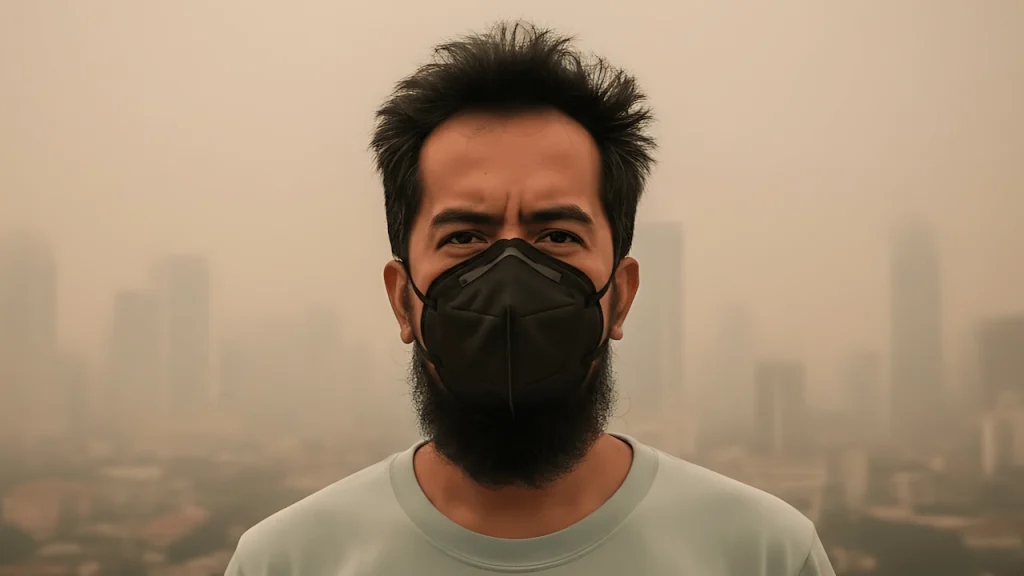
Metro Manila’s air quality hit acutely unhealthy levels this week, with several monitoring stations reading well into the 200s and 300s on the AQI scale. Quezon City suspended in-person classes. None of the fires causing it are in the Philippines. The smoke is drifting in from Indonesia, roughly 2,000 kilometers away, carried on the same southwest monsoon winds that bring the rainy season. Whatever brought you here searching for an N95 mask, here’s what’s actually happening and what protects you through it.
This article has Amazon links. The Amazon links in this post are chosen because they’re directly relevant to the topic, not random placements.
Buy through them = small commission for HealthyForge. Your price stays the same. Zero paid placements. Zero bullshit supplements.
☕ Or just support directly and cut out the middleman.
What Transboundary Haze Actually Is
Indonesia’s disaster management agency has six priority provinces battling land and peatland fires right now: Riau, Jambi, and South Sumatra on the island of Sumatra, and West, Central, and South Kalimantan on Borneo. Peatland fires are especially hard to put out and produce dense, sustained smoke rather than a quick burn. When the southwest monsoon (habagat) is active, it carries that smoke northeast, across the South China Sea, and into the Philippines.
This isn’t a one-time event. Indonesia’s fire season and the Philippines’ habagat season overlap most years between August and September, which means this specific problem, smoke from a fire you can’t see affecting air you have to breathe, tends to recur annually rather than being a single freak occurrence. This particular episode is expected to persist for several days before rain and shifting wind patterns clear it, assuming the fires themselves don’t intensify further.
What PM2.5 Actually Does to You
The haze you’re breathing is mostly fine particulate matter, PM2.5, small enough to travel deep into your lungs and, from there, into your bloodstream. Short-term exposure at these levels causes eye, nose, and throat irritation, coughing, and shortness of breath in otherwise healthy people. For anyone with asthma, COPD, or existing heart or lung conditions, it can trigger flare-ups and, in more severe cases, has been linked to increased hospital admissions and cardiac events. Children and older adults are consistently the most affected groups in the research on this, both because they’re more physiologically sensitive and because they often spend more time outdoors or can’t control their exposure the way an adult managing their own schedule can.
This is the part that makes the gear below worth buying. A mask isn’t a comfort item during haze season, it’s directly reducing how much of this you’re actually inhaling.
Use this to see where each option fits before reading the breakdowns below.
| Type | Filtration | Best For | Limit/Note |
|---|---|---|---|
| N95 (disposable) | 95%+, NIOSH-certified | Verified protection, single haze episode | Single-use, cost adds up over a full haze season |
| KN95 (disposable) | Comparable to N95 when genuine | Easier to find in bulk during shortages | Counterfeit KN95s are common, verify the source |
| Double medical mask / Cloth Mask with Filter Pocket | Below N95/KN95 | Fallback only, when neither is available | Better than nothing, not a real substitute |
| Reusable respirator (carbon filter) | Comparable to N95 with correct filters | Daily wear through a multi-day haze episode | Higher upfront cost, pays off with reuse |
| Half face respirator (cartridge) | Highest, industrial-grade | Outdoor work or cleanup during haze | Overkill and impractical for a normal commute |
Disposable Masks: N95 vs. KN95
N95 is the U.S. standard, regulated by NIOSH, and filters at least 95% of airborne particles when properly fitted. KN95 is the equivalent Chinese standard and performs comparably when it’s a genuine, properly certified mask, which matters because counterfeit KN95s are a real problem in the market. For PM2.5 specifically, either does the job if it fits snugly against your face with no gaps at the nose or chin, since a poor seal defeats the filtration rating regardless of what’s printed on the mask.
NIOSH-Approved N95 Masks — The safest default if you want certification you can verify. Look specifically for a NIOSH approval number printed on the mask itself, not just the packaging.
KN95 Masks — A reasonable alternative, and often easier to find in bulk during a run on N95 supply. Buy from a source that can verify certification rather than the cheapest bulk listing you find.
If neither is available, the DOH’s own fallback guidance is double masking with two ordinary medical masks, or a damp cloth over the nose and mouth as a last resort. Neither matches N95/KN95 filtration, but both reduce exposure more than nothing.
Reusable Respirators: The Option Most People Never Consider
Disposable masks are single-use and add up in cost if you’re wearing one daily through an entire haze episode or an entire haze season. A reusable respirator with replaceable filter cartridges solves that, and this category also happens to fit the “doesn’t look like disaster gear” problem the same way a Chelsea-style rain boot beats a generic rubber one. Tactical-styled reusable masks with carbon filters look more like sport or work gear than medical equipment, which matters if you’re wearing one on a commute or at school every day for a week.
Reusable Respirator Mask with Filters — Replaceable activated carbon filters, adjustable strap, built for repeated daily wear rather than single use. The cost evens out fast if haze season runs more than a few days, which it usually does.
Half Face Respirator — Heavier-duty, cartridge-based filtration, the same category used for construction, painting, and industrial dust. Overkill for a normal commute, but worth knowing about if you’re doing outdoor work or cleanup during a haze episode rather than just walking through it.
The Habit Nobody Talks About: Don’t Bring the Haze Inside With You
A mask protects your lungs while you’re outside. It doesn’t stop PM2.5 from settling on your clothes, skin, and hair, and if you walk straight from outside to your bed or couch in the same clothes, you’re carrying that exposure into the one place you’re trying to keep clean. The same logic that made sense during the pandemic applies here: change out of the clothes you wore outside instead of letting them sit in your bedroom, and shower after extended outdoor exposure. It costs nothing and closes a gap that buying a better mask alone doesn’t.
Indoor Air: Where This Connects to What You Already Have
Everything above is about protecting yourself while you’re out in it. Once you’re home, the goal shifts to filtering PM2.5 back out of the air you’re breathing indoors, which is a separate problem with a separate solution. If you haven’t already set that up, HealthyForge’s guide to the best air purifiers for a bedroom covers that half of it. Outdoor protection and indoor filtration aren’t the same fix, you need both to actually reduce your total exposure through a haze episode.
This Happens Most Years. Build the Habit Now.
This week’s haze will clear once the wind shifts or the rain returns, but the overlap between Indonesia’s fire season and the Philippines’ habagat season isn’t a one-off. Having a mask on hand, knowing the difference between N95 and KN95, and building the outdoor-clothes habit now means you’re not scrambling to find supply the next time this happens, because it likely will.