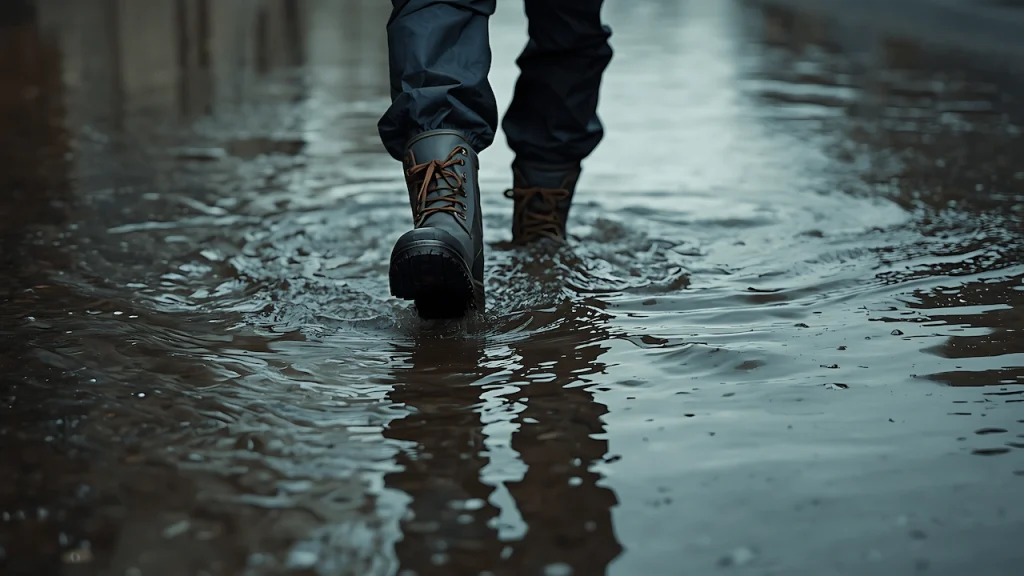
My waterproof boots lasted about 10-15 minutes into knee-deep floodwater before it didn’t matter that they were “waterproof” anymore. Water got in anyway, and now I was walking around with a heavy, soaked boot that stayed wet for hours instead of keeping me dry at all. That’s the problem with how flood gear gets sold: one product, marketed as the fix, that quietly stops working the moment your actual situation goes past whatever depth or duration it was tested for.
This article has Amazon links. The Amazon links in this post are chosen because they’re directly relevant to the topic, not random placements.
Buy through them = small commission for HealthyForge. Your price stays the same. Zero paid placements. Zero bullshit supplements.
☕ Or just support directly and cut out the middleman.
Why Urban Flood Wading Is Its Own Danger
A flood in a city isn’t a wilderness survival scenario. It’s your normal commute, your normal street, except now there’s contaminated water between you and work, school, or home, and life doesn’t pause for it. A no-work, no-class day usually covers the first day or two. After that, if the water’s mostly gone from where the news cameras are but your specific street or neighborhood is still knee-deep, you’re expected to show up anyway.
That water carries Leptospira bacteria, entering through skin contact and especially through cuts or scrapes you might not even notice you have. Prolonged wading also sets up trench foot (skin breakdown from feet staying wet and cold for hours) and creates the damp conditions athlete’s foot and jock itch thrive in. If those two keep coming back for you specifically, here’s why athlete’s foot recurs and why jock itch does too — this post isn’t re-explaining the fungal mechanics, it’s about not putting yourself in the conditions that trigger them in the first place.
Even trained rescuers get caught underequipped in this exact situation. If the people whose job is flood response show up without the right gear for sustained wading, that’s proof there’s no standard kit that solves this for everyone. Your setup has to match your actual water depth, your actual duration in it, and your actual life (office worker, student, parent doing a supply run), not a generic checklist.
What this gear doesn’t solve: drowning in moving water, waterborne illness from swallowing floodwater, dengue from stagnant water afterward, injury from debris. Those need separate precautions. This is specifically about the skin-contact and prolonged-exposure risk that gear can actually fix.
There’s No Flood Gear Kit. Here’s Why That’s the Point.
Every “flood survival kit” you’ll find online is the same FEMA-style bundle: food, water, a tent, blankets, a flashlight, built for being cut off from home for three days. None of it addresses what you actually wear on your body to wade through water today and get where you’re going. That gap exists because a packaged kit has to be generic enough to sell to everyone, which means it’s specific enough for no one.
Someone crossing an ankle-deep flooded street for five minutes needs almost nothing. Someone wading knee-deep for twenty minutes to get home in a low-lying, flood-prone area needs a completely different setup. A single SKU can’t serve both without either being overkill for one person or useless for the other.
This is also why you might already own half of what you need without realizing it. If you’ve got waterproof or tactical boots from hiking, work, or any outdoor hobby, or a pair of waterproof MTB or cycling pants sitting in a closet, you’re not starting from zero. The gap is usually somewhere specific: boots but nothing covering the calf once water goes over the shaft, pants but nothing protecting your phone, a good bag but no plan for what happens to your feet inside it. Go through what you already have category by category before buying anything new. That’s the actual exercise this post is for.
Why Boots Alone Aren’t Enough
“Waterproof” on a boot means sealed up to the shaft and at the seams, tested for a specific depth and duration, not an unlimited guarantee. Once water goes over the top, or sustained pressure at depth works its way through the seams, the boot doesn’t just fail to help, it actively works against you. Now you’re carrying trapped water around for hours, heavier and wetter than if you’d worn nothing waterproof at all.
Boots are still worth having as your base layer of protection and they’re still the right entry point for most people. The mistake is assuming they’re the whole solution instead of one layer in a system that needs backup.
The Real Answer: Layering, Not One Product
This is the MacGyver part, closer to how bikepacking rain gear gets combined than to a curated “flood kit” sold as one purchase. Boots handle the entry-level exposure. Waterproof socks or calf-high wading socks pick up where the boot’s shaft ends. A waterproof baselayer or pair of waterproof pants worn under your regular clothes covers anything the boot and sock combination misses, and does it invisibly enough that nobody has to know you’re wearing flood gear to work. Combined, this is what actually keeps skin dry through sustained wading. None of them alone gets you there.
Who This Is Actually For
Office workers who still have to show up once the initial storm day passes. College students who don’t have the option of skipping a knee-deep street crossing in a skirt or slacks, where a boot alone solves nothing and a baselayer worn underneath actually does. Parents doing supply runs. Anyone in a flood-prone area where the water clears from the main roads days before it clears from their own street. This isn’t recreational gear for people who chose to be in the water. It’s for people who don’t have a choice about it.
Quick Pick
If you’re auditing what you have and filling the gap: a membrane waterproof sock like the Dexshell Waterproof Socks paired with a waterproof baselayer or pair of over-trousers is the combination that covers what boots alone miss, without requiring you to replace boots you already own. If you’re starting from zero, add a pair of waterproof boots to that combination as your base layer.
Build Your Setup: Category by Category
Use this to audit what you already have before reading the breakdowns below.
| Category | Protects Against | Best For | Depth/Duration Limit |
|---|---|---|---|
| Waterproof Shoes for Men / Women | Ankle-level skin contact, debris underfoot | Base layer, everyone | Fails once water tops the shaft or after sustained pressure at depth |
| Membrane waterproof socks | Ankle-to-calf skin contact | Daily commute through ankle-to-mid-calf water | Cuff can still let water in if fully submerged past the top |
| Neoprene wading socks | Knee-level skin contact, repeated submersion | Deeper wading, shorter stretches | Traps heat and sweat, wrong for all-day wear |
| Waterproof over trousers / baselayer | Full-leg skin contact | Office wear, school uniforms, anyone needing it invisible under clothes | None if worn correctly, but doesn’t cover feet on its own |
| Waterproof backpack | Laptops, documents, anything that can’t get wet | Anyone carrying electronics | Submersion-rated bags only, splash-rated bags aren’t the same protection |
| Waterproof phone pouch | Phone specifically | Everyone, regardless of other gear | Cheap enough to have no excuse to skip |
Boots: Your Base Layer
If you already own waterproof or tactical boots, you likely don’t need to buy this category. If you don’t:
Waterproof Work Boots — Sealed shaft, built for repeated wear, the right starting point if you’re building this system from nothing.
Waterproof Hiking Boots — A lighter option if all-day comfort during a normal commute matters more than maximum sealing.
Waterproof Shoes for Men — A lower-profile option than a full boot if a shoe fits better under work pants or matches a uniform dress code, while still sealing at the seams for ankle-level wading.
Waterproof Shoes for Women — Same category, sized and fitted for a lower-profile everyday shoe rather than a hiking boot, which matters if the rest of the outfit (office wear, a uniform) doesn’t accommodate bulkier footwear.
Socks: The Gap Boots Leave Open
This is the piece almost nobody already owns, because it’s not gear people buy for any other reason.
Dexshell Waterproof Socks — Three-layer membrane construction, holds up to extended wear without the clammy feeling cheaper waterproof socks get criticized for. Comes in ankle, mid-calf, and knee-length, and the mid-calf or knee version is the one that actually matches typical flood depth for a commute.
SealSkinz Waterproof Socks — The Hydrostop cuff design seals at the top of the sock specifically to stop water dripping down your leg into the sock, the usual failure point for waterproof socks otherwise. Worth the price difference if you’re moving through water repeatedly, not standing still.
Neoprene Wading Socks — For knee-deep or deeper, repeated submersion. Runs warmer and sweatier than membrane socks, so it’s the wrong pick for an all-day office commute but the right one for genuinely deep water over shorter stretches.
Pants and Baselayers: Full Coverage Under Your Regular Clothes
Waterproof Over Trousers — Worn over your regular pants, not a replacement for them. This is the category that solves the skirt problem and the office-slacks problem: full coverage that goes on when you need it and comes off when you don’t.
Waterproof Baselayer Leggings — Worn under your clothes instead of over them, for anyone who needs the protection to stay invisible all day rather than put on right before wading. Look specifically for “waterproof” membrane construction rather than “water-resistant,” since sellers use the two terms interchangeably even though only one actually stops skin contact during submersion.
Bags and Electronics: The Fear People Actually Feel
Most people aren’t thinking about leptospirosis when they see floodwater ahead. They’re thinking about their phone.
Waterproof Backpack — Full submersion-rated, not just rain-resistant, if you’re carrying a laptop or anything you can’t afford to lose.
Waterproof Phone Pouch — Cheap enough to keep one in every bag you own, no reason not to have this regardless of what else you’re carrying.
This Is a Get-Home Kit, Not Recreational Gear
None of this is about being ready for a swamp hike or a planned outdoor trip. It’s about getting through the days your commute doesn’t stop just because there’s floodwater in the way, and doing it without paying for it in your skin weeks later. Audit what you already own first. Fill the specific gap, not the whole list. And if you want the broader emergency-preparedness system this fits into beyond just flood-specific gear, HobbyEngineered’s go bag breakdown covers that side of it.