Someone handed you a paddle, told you the rules would make sense after two rallies, and now you’re standing on a court wondering two things: is this actually going to be good for you, and do you need to buy anything before you go back. Both are fair questions, and neither has the answer the gear-listicle sites want to sell you.
Here’s the honest version. Your first session needs almost nothing. Your second session is where the real decisions start, and even then, most of what gets marketed at new players is optional. This is what actually mattered, in the order it mattered, from someone who showed up in trekking shorts and a cotton shirt the first time and figured the rest out from there.
Is pickleball actually low-impact?
“Low-impact” gets thrown around loosely, so here’s the functional version instead of the marketing version.
Pickleball is lower-impact than running or basketball because you’re not absorbing repeated vertical ground-reaction force. You’re rarely jumping, and the court is a quarter the size of a tennis court, so you’re not sprinting baseline to baseline. That’s the part that’s true.
What it doesn’t spare you from is lateral movement demand. A lot of pickleball is short, sharp side-to-side steps and quick direction changes chasing dinks at the kitchen line (the non-volley zone). That’s where the knee and ankle stabilizer muscles do real work, and if those haven’t been loaded in a while, that’s where you’ll feel it. Not from impact, from control.
The other honest point: your wrist and forearm take more repetitive load than you’d expect for something that looks casual. Dinking and resetting shots at the net is mostly wrist and forearm, done over and over, for an hour or more. That’s a different kind of fatigue than cardio fatigue, and it’s the one new players underestimate.
So: legitimately gentler on your joints than higher-impact sports, genuinely still demanding on stabilizers and connective tissue that haven’t been used that way recently. Both things are true at once.
This article has Amazon links. The obvious kind that connect to what we just talked about, not random products we pretend fit.
Buy through them = small commission for HealthyForge. Your price stays the same. Zero paid placements. Zero bullshit supplements.
☕ Or just support directly and cut out the middleman.
What your body needs to know before you go back
Nobody hands you a warm-up plan with the paddle, so here’s the practical version. A few minutes of ankle circles, lateral lunges, and wrist rotations before you start covers the specific movement patterns pickleball actually asks of you, and it’s more useful than a generic five-minute jog.
The common early strain points, in order of how often they show up for players getting back into activity:
- Wrist and forearm, from the repetitive dinking motion described above
- Calf and Achilles, from repeated quick lateral pushes off, especially if you’re playing on hard outdoor concrete
- Lower back, from the low paddle-ready stance held over long points
None of that means don’t play. It means the recovery side of this is worth taking as seriously as the gear side, and it’s genuinely not something you need a court-side pro shop to sell you:
- A topical pain relief rub for end-of-day forearm or calf soreness.
- A wrist compression sleeve if the dinking fatigue is the thing you notice first.
- KT tape for a knee or ankle that’s talking to you without being actually injured.
- A foam roller for calves and forearms after. This one earns its space in your bag faster than a second paddle will.
The gear that’s actually on you
Here’s the part the listicles skip because it doesn’t sell anything expensive: most of what you need for session one, you probably already own. It’s just not what you’d guess.
What I actually wore the first time: trekking shorts and a plain cotton shirt. The shirt was the problem. Cotton doesn’t wick moisture, so by the second game it’s heavy, sticky, and clinging. Annoying, not dangerous, but enough that I noticed it every single point. The trekking shorts were the second problem, less obvious until you’re mid-lunge: they’re built for stride length, not lateral movement, so they restrict exactly the motion pickleball needs most.
For session two, I didn’t jump straight to sport-specific gear. I trialed my mountain bike shorts instead, since they already had the stretch trekking shorts didn’t. That held up fine as a bridge option before I eventually moved to actual badminton/pickleball gear, which is built for the same lateral, low-stance movement pattern.
The takeaway isn’t “buy pickleball-branded clothing.” It’s this: a moisture-wicking dri-fit shirt solves the cotton problem immediately. Dri-Fit Shirt and Athletic Shorts with real stretch across the hip (athletic, badminton, or training shorts, not hiking shorts) solve the movement restriction.
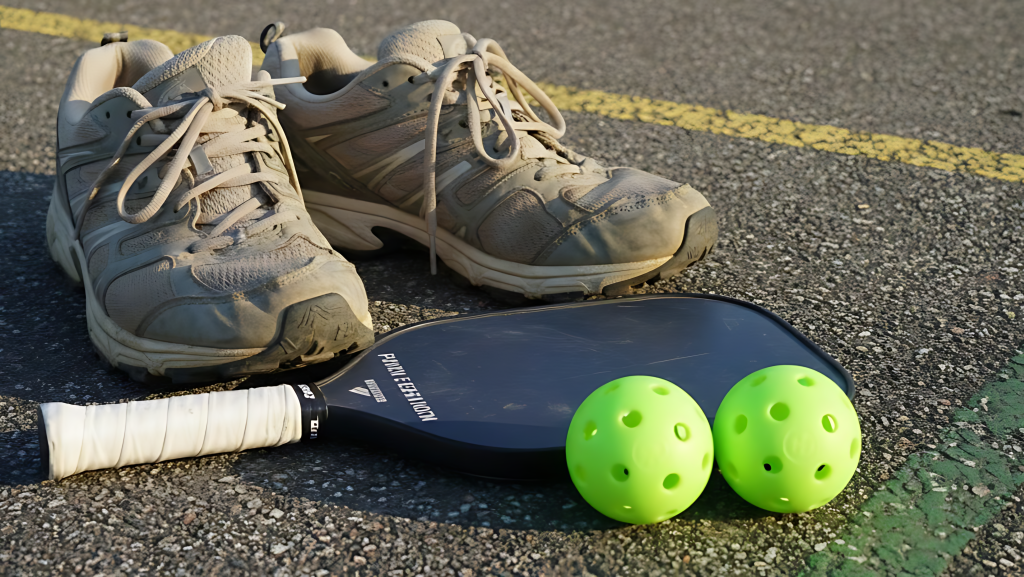
Shoes are the one place I’d tell you not to wait. I’ve been playing in Adidas Terrex AX4 Mids, a trail shoe, because that’s what I owned. It works, in the sense that I haven’t rolled an ankle. But it’s the wrong tool: the lug pattern is designed to grip loose dirt and rock, not indoor court flooring or outdoor sport-court surface, so it doesn’t release smoothly during quick pivots the way a court shoe does. A trail shoe’s ankle-mid cut also isn’t built for the lateral cutting pickleball asks for; it’s built for forward hiking stability, not side-to-side. If you’re going back more than once or twice, a proper court shoe is the single highest-value purchase on this whole list.
If you’re hooked: paddles and balls
This part is genuinely optional until you know you’re going back regularly. If you’re at that point, here’s what actually matters.
Paddles. Weight and grip size matter more than brand name. A lighter paddle (roughly 7.3 to 7.8 oz) reduces the repetitive wrist strain covered above; a larger sweet spot forgives off-center hits, which you’ll have plenty of early on.
| Paddle | Key spec | Honest take |
|---|---|---|
| Selkirk beginner-line paddle. | Lightweight, larger sweet spot | Best balance for someone still developing consistent contact |
| JOOLA paddle. | Textured fiberglass face | Solid all-around control paddle for regular players |
| Paddle marketed for tennis elbow / arm comfort. | Lower vibration transfer, lighter swingweight | Worth prioritizing specifically if your forearm was the strain point from Section 2 |
Balls. Indoor and outdoor balls aren’t interchangeable. Outdoor balls are harder, with smaller, more numerous holes to handle wind and rougher surfaces; indoor balls are softer, lighter, with larger holes, built for smooth gym flooring. Using the wrong one changes the ball flight enough that it’s worth getting right.
- Outdoor: Franklin X-40.
- Indoor: a soft indoor-rated ball pack.
So, worth it?
If you’re coming back to activity after a while, or you got roped into a session by someone who handled everything, the honest answer is yes, with the caveat that it’s genuinely demanding on your wrists and stabilizer muscles even though it’s easy on impact. You don’t need to buy anything for session one. By session two, the two things actually worth owning are court shoes and a dri-fit shirt. Everything else, including the paddle, can wait until you know you’re going back.