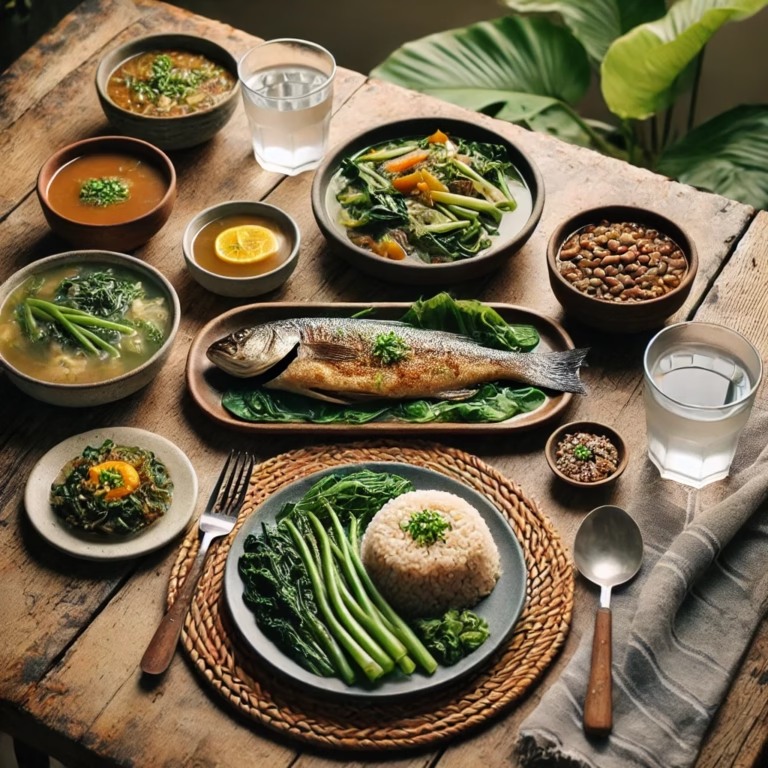
Perfect meals fail the moment real life shows up.
Travel breaks schedules. Long drives kill appetite. Physical effort does not wait for a clean kitchen, a macro plan, or a neatly timed plate. When output still matters and conditions are imperfect, the question stops being “what is ideal” and becomes “what keeps the system running.”
That is where portable calories win.
This is not about nutrition ideology. This is about staying functional when time, motion, and effort are already in play.
The problem with perfect meals
Perfect meals assume stability. They assume time, appetite, utensils, and a body that is not already under load. In practice, those assumptions fail fast.
People skip meals not because they are lazy, but because logistics collapse. Travel compresses time. Work drains attention. Physical activity suppresses hunger. When fueling depends on ideal conditions, energy gaps appear, and performance drops quietly.
The result is familiar. Fatigue shows up before hunger. Focus degrades. Output drops. Recovery suffers. Not because calories are unavailable, but because the delivery system is fragile.
Portable calories solve that problem by design.
When consistency matters more than perfection, meal replacement powders are one of the more practical ways people cover calories without overthinking it.
What portable calories actually mean
Portable calories are not snacks. They are not treats. They are calories that survive movement.
They share a few traits:
- High energy density per bite
- Minimal preparation
- Predictable digestion
- Easy transport
- Low disruption during activity
The goal is not pleasure or optimization. The goal is continuity. Energy in without friction.
This is where peanut butter earns its reputation.
Peanut butter as a baseline fuel
Peanut butter works because it is boring in the best possible way.
It is calorie dense. A small amount carries meaningful energy. It is fat dominant, which slows digestion and stretches energy delivery. It contains enough protein to improve satiety without demanding recovery level digestion. It does not spike blood sugar on its own. It does not require cooking, refrigeration, or special handling.
Most importantly, it stays quiet in the stomach.
That matters more than most nutrition advice admits. Under motion, heavy digestion is a liability. The body diverts blood flow away from the gut during effort. Foods that demand complex digestion create discomfort, bloating, or nausea. Peanut butter does not.
This is why lifters reach for it during bulking phases. This is why cyclists pack it. This is why it shows up in emergency food kits. It is not exciting, but it is reliable.
Peanut butter and bread, why the pairing works
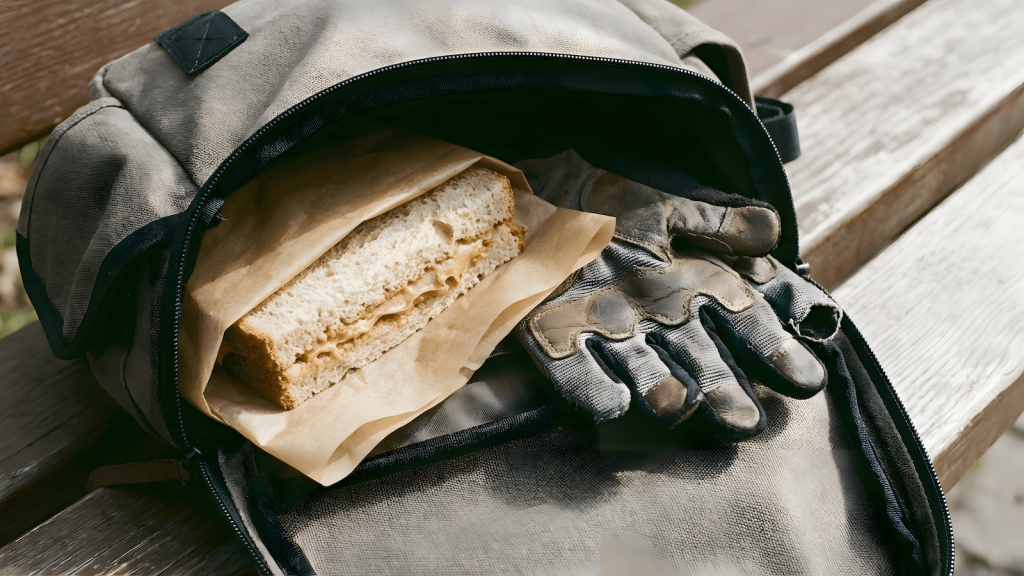
On its own, peanut butter burns slow. Bread on its own burns fast. Together, they flatten the energy curve.
Bread provides immediate carbohydrate availability. Peanut butter slows the overall digestion and extends the release. The combination creates usable energy without a sharp spike or crash.
For practical use, this matters in a few common situations:
- Long drives where meals are delayed
- Biking or walking where continuous motion suppresses appetite
- Workdays where a full meal would cause lethargy
- Missed breakfasts that still require physical or mental output
The sandwich format matters too. Folding or rolling the bread reduces chewing effort and air intake. Smaller, repeatable bites reduce stomach load. This is why people instinctively compress their food under motion. It is not accidental. It is adaptive.
This is not a meal replacement, and that is the point
Calling a peanut butter sandwich a meal misses the point.
It is not meant to replace balanced nutrition. It is meant to prevent energy failure when balance is temporarily unavailable. It fills the gap between ideal and real.
Used correctly, it preserves output. Used incorrectly, it quietly adds calories without purpose. The difference is intent.
Portable calories are not about eating less well. They are about not breaking down when perfect meals are unrealistic.
What happens when you add honey
Adding honey changes the behavior of the system.
Peanut butter alone is slow and forgiving. Honey is fast and sharp. When combined, the fuel profile shifts.
Honey introduces quick access carbohydrates. Glucose enters the bloodstream faster. Glycogen replenishment accelerates. Energy arrives earlier in the effort window.
This changes when and why the food should be used.
Peanut butter alone versus peanut butter with honey
Peanut butter with bread functions as stable fuel. It supports long duration, steady output. It works well during travel, long drives, and sustained low to moderate activity.
Adding honey turns the same food into timed fuel.
This combination makes sense when:
- Effort is about to begin
- Pace or intensity is increasing
- Energy depletion is already present
- You need usable energy now, not later
For example, before a bike ride rather than during a long drive. Before lifting rather than during a sedentary work block. Early in exertion, not late at night.
Honey is not an upgrade. It is a modifier.
Where honey causes problems
Honey fails when intent is missing.
Used during inactivity, it creates unnecessary blood sugar swings. Used late at night, it disrupts appetite regulation. Used casually, it increases calorie intake without performance return.
Peanut butter forgives misuse. Honey does not.
This is why adding honey should always be conditional. It belongs near effort, not near rest.
Real world use, travel and motion
For long drives, plain peanut butter sandwiches work because they deliver energy without heaviness. They prevent energy dips without triggering post meal lethargy. Digestion stays simple. Focus stays intact.
For biking or movement, folded or rolled sandwiches work because they are easy to handle and digest. They provide repeatable energy without forcing stops or full meals.
In both cases, the goal is the same. Maintain energy without interfering with the task.
Honey only enters the picture if effort intensity demands it. Otherwise, stability wins.
What to ignore
A few narratives are worth discarding:
- The idea that every eating event must be optimal
- The belief that missing meals is a discipline failure
- The assumption that sugar is always the enemy
- The pressure to turn every food choice into a moral decision
Under load, systems matter more than ideals.
How to use this without overthinking it
Keep it simple.
- Peanut butter and bread as default portable fuel
- Honey only when effort justifies speed
- Use during movement, travel, or workload compression
- Do not treat it as a recovery solution
- Do not stack it mindlessly on top of full meals
This is not a diet. It is a contingency plan.
The actual takeaway
Perfect meals only work when life cooperates.
Portable calories work when it does not.
Peanut butter succeeds because it respects reality. It is dense, stable, portable, and predictable. Adding honey changes timing, not quality. Used with intent, both have a place.
Healthy Forge is not about chasing ideal conditions. It is about staying functional when conditions are imperfect. Portable calories are not a shortcut. They are a tool for continuity.
When the system holds, progress follows.

Survival-First Wellness Strategist & Tactical Health Writer
Founder of HealthyForge.com, focused on fuel, recovery, and health systems that work when life is messy.
Writes for people who move, travel, miss meals, and still need their body to cooperate.